Posts Tagged ‘my books’

BIG BANG COSMOLOGY IS WRONG

February 20, 2021

If you wanted to know what to think of some fringe activity such as Spiritualism or Water Divining I doubt one would consult a professional first. After all you know that they must be committed. But what if you wanted to evaluate Big Bang Cosmology? Once again you can’t turn to the biased professionals, although they might argue that unless you are a professional you cannot know enough about the subject to take an informed position. But of course that is a dangerous stance to adopt, and the way in which priesthoods germinate, metastasize and sometimes come to dominate the world. They become immune to criticism because they will admit none but believers as critics. They become malignant, if not necessarily malign.

So what is the wise outsider to do? I would suggest they might consult those whose business it is to know much about the arcane subject- material in question without having to become paid exponents themselves. Cosmology for instance is in practice largely extra-galactic astronomy, so why not consult an extra-galactic astronomer who doesn’t claim to be a Cosmologist? Such an astronomer will know most of the technical arguments – without having to commit to them. That is where I stand with regard to Big Bang Cosmology, or BBC. My passion lies in Galaxies, the largest discrete objects in the Universe. But as they seem to be almost as old as the Cosmos, their origin must be entangled in the early evolution of the Universe itself, so I cannot ignore Cosmology, any more than Cosmology can ignore Galaxies which, so far as we know, comprise most of everything we can actually observe. And as visible galaxies exist in hundreds of thousands of millions, and can be observed in some detail nowadays, they should tell us more about Cosmology than vice-versa. And here is the rub: in BBC galaxies shouldn’t exist. As has been known for fifty years they would have been torn apart by radiation pressure before they could even form. So a desperate fix called CDM, standing for ‘Cold Dark Matter’ was adopted to try and repair the awful hole in the story. But despite many efforts to find out what it is, no one has been able to find any trace of CDM in half a century. Umm.

And there is another stark confrontation between galaxies and Cosmology. In an expanding Universe – the core assumption of BBC – distant galaxies should be totally invisible because of the ‘Tolman Effect’, a test for Expansion, which goes back to 1930. Then we didn’t possess the the telescopes to test it, but now, in the Hubble Space Telescope, we certainly do. And what do we find? That the observed Universe fails – and fails most dramatically – as you can see for yourself. Look at the figure:

The Hubble Ultra Deep Field, the deepest image of the Universe , taken with the Hubble Space Telescope, which I helped to design. All those tiny dots are actually high redshift galaxies a long long way away. If the Universe is really expanding we shouldn’t be able to see them. But……..

You can see it’s covered all over with a rash of tiny high-redshift galaxies – which simply shouldn’t be there, not if the Universe is expanding. If it was they ought to look no less than ten thousand times dimmer than they appear to be. Surely this is something BB Cosmologists ought to acknowledge? But they don’t. It’s been known since 1993 when we first fixed the telescope’s aberrated mirror, but ever since there has been a conspiracy of silence about the matter. As a designer of the existing and earlier cameras, I was staggered when I first saw the earliest deep Hubble images because I’d been assured by Cosmologists that Hubble would never see high-redshift galaxies. Yet there they were. There they are in their hundreds and thousands.

The only precedent I can think of occurred back in 1610 when Galileo pointed his little spyglass at Venus and found it to be a brilliant crescent pointing towards the Sun. The two-thousand-year-old Geocentric picture of the Cosmos was quite wrong, All the Planets, including the Earth, must be orbiting the Sun.

But what happened? Galileo was eventually seized by the Inquisition, forced to retract, and then imprisoned for life.

We don’t have an Inquisition any more but we do have Priests of a different kind: experts whose livelihoods, reputations and ambitions enforce adherence to a certain dogma. It’s not easy when you are an elderly, respected professor of Cosmology, with several books and hundreds of peer-reviewed papers behind you, to admit that you have been wasting yours, and everybody else’s time. And if the old won’t recant, why should the young, who still have their reputations and their livings to make? There is no Inquisition it is true but there are, in a highly competitive profession, appointment and tenure committees to please, journal-referees to propitiate. Brave myths to the contrary, academic success is based above all on allegiance to the Common Book of Prayer.

I know it will be hard for outsiders to believe in such conformity, I certainly wouldn’t have believed in it myself if I hadn’t experienced it at first hand, and to some extent colluded rather shamefully in it myself. Yes I went to conferences and politely pointed out the anomalies facing us in the sky. I even published papers in elite journals like ‘Nature’ demonstrating that real galaxies couldn’t possibly have formed in the CDM manner proclaimed by cosmological theorists. But when nobody responded, shouldn’t I have bellowed and trumpeted my doubts?

Honestly I should. But two things held me back; lack of self -confidence for one. Cosmology is a huge and complex subject mired in the hardest Mathematics and Physics – and perhaps I’d missed something – which the experts had not? Then again it wasn’t my real love. If I acquired a reputation as a madman I wouldn’t get the observing time on top telescopes I absolutely needed to do my Galaxy research. Many of us subscribe to popular myths, knowing them to be untrue. One well-known colleague told me that when he is applying for observing time he always alludes to CDM, which he knows to be diseased, because he’s found that if does not, he won’t get the time. And so CDM, a central dogma of BBC, continues alive, when it is so obviously wrong.

But enough of personal anguish and Sociology. How could the uncommitted thinker look dispassionately at the arguments for and against BBC and come to a balanced opinion?

There is a way – using Common Sense – if you know how it works – which most scientists, let alone other scholars, do not. All it will deliver is a provisional conclusion, with some kind of Odds on it attached. What I will do next is to exhibit two different attempts of mine to have a go at the BBC problem, so that readers can appreciate some of the philosophical subtleties involved.

The first, entitled “Doubts about Big Bang Cosmology” was published back in 2011, where my Odds against it being broadly right were only 4 to 1, disappointing, but hardly decisive. It is reasonably short yet contains the main arguments in a not too technical fashion I hope, so readers may care to see how those Odds were reached. You can find it at

https://mjdisney.org/wp-content/uploads/2021/02/Doubtsbigbang-copy.pdf

In cosmology itself nothing much changed dramatically over the next 4 years. But my understanding of Common Sense did when, in 2015, I stumbled upon the vitally important PAW or ‘Principal of Animal Wisdom’, indispensable to all thinkers who might otherwise be blown wildly off course by Systematic Errors. Now my Odds against BBC shot up dramatically to 128 to 1 against it being broadly right. Not only are they far more conclusive but they are , in my opinion , far more robust too because they rely on a whole network of interlocking and broadly concordant evidence. Without any need to repeat the cosmological arguments the new Inference Table, with its condemning Odds O(H|E) {i.e Odds on the Hypothesis H given all the evidence E} is briefly exhibited at

https://mjdisney.org/wp-content/uploads/2021/02/SCAMBBCTable-copy.docx

The conclusion I would draw from all this is that the Universe is trying to tell us something profound and interesting about itself, but we professionals, soaked in our preconceptions, and deafened by our Church choir, are unprepared to listen. After Galileo’s experience we should have anticipated, and some of us on board the Hubble did. But ….

Our susceptibility to misconceptions lies in our weak grasp of Common Sense today, and in particular our total ignorance of PAW, or The Principle of Animal Wisdom. Animals whose very survival depends on sound judgements, cannot afford to be taken in by misleading clues. So how do they discount them? That was the question I asked myself back in 2015. The answer is they cannot allow any single clue a predominating Weight – because that clue might be false, and fatal. They must rely on a network of weaker clues which reinforce one another. That is what I call PAW. And when I apply it to BBC the Odds against it shoot dramatically up. BBC can’t be right, it can’t. Something at least about it is deeply wrong, never mind the technical details. [To see more on the PAW go to Post ‘ANIMAL WISDOM & US’ in ‘Thinking’ Category].

If the PAW is so damned vital for animals then how did we ever lose sight of it? Because Priests preach Certainties – their influence, their power and their livelihoods all depend on proclaiming Certainties, whilst the PAW stands out firmly against them. And, to be fair, many of us prefer Certainties to uncomfortable uncertainty – which is all the natural world has to offer. So over the last few thousand years the PAW, which is grown-up, has become submerged by a childish and misbegotten craving for Certainty, which only priests, but not men of Common Sense, can deliver. As Voltaire put it: “Uncertainty is uncomfortable; Certainty is absurd.” See a talk on Youtube by me on this topic at

https://www.youtube.com/watch?v=KskJrJmfr34

What IS the universe trying to tell us ? It could be exciting.

THE DECLINE OF GREAT BRITAIN: 1

December 16, 2020

How innumeracy has led successive British governments into disastrous economic follies.

In 1820 Britain stood, a lone Collossus, above the world. By 1920 a dozen other nations had higher per-capita GDP. In 2020 we seem even closer to the fringe of things: timid, divided, decaying, relatively impoverished and weak. What happened?

I am going to argue here , through specific examples, that having an innumerate ruling (and media) elite, as we have, is akin to being driven by a drunk.

(A) Leverage (The baboons in the reactor)

The banking crash of 2008. halted progress, stalled incomes, led to austerity, closed social programs and libraries, generated misery and uncertainty, and yet was totally avoidable. Because the ex- Chancellor Gordon Brown, and all his high-powered Treasury officials, were ignorant of simple algebra, they had allowed the Leveraging of bank loans to rise from less than 25 in 1995, already far too high as we shall calculate, to over 50 by 2008. Whatever else was going on, that was bound to lead to a crash. If Brown hadn’t been so innumerate [he did have a PhD in ‘economic history’, which probably made him unjustifiably over-confident] he might even have persuaded his US counterpart ( Alan Greenspan, another innumerate) to behave sensibly. But while Brown was boasting about his “Prudence” he had been blindly driving our bus towards the cliff edge.

A leverage of 50 allows investors to borrow 50 times their own invested capital and so, in a rising market, to double their money every year. How clever, how miraculous! But there ain’t no such things as miracles — even Gordon Brown should have known that. If the market falters, such highly leveraged investors, be they banks or individuals, can lose all their money almost overnight and default on their loans. Banks then panic or crash, and ordinary citizens who were either too wise, too moral or too poor to plunge into the fools’ bonanza, were forced to bail the greedies out. All because Brown and his Treasury wise-acres couldn’t do simple sums. If you want to see just how bloody simple that sum was go to:

https://mjdisney.org/wp-content/uploads/2021/01/Leveragecalc.pdf

(B) Malthus’ Essay on Population.

Follies of innumeracy are by no means uncommon, or new. In 1798 the Revd. Thomas Malthus, a don at Cambridge, published his highly influential “Essay on the Principles of Population”. In it he argued that an unrestrained population would always multiply faster than its food resources, leading inevitably to starvation, to misery, and to a “struggle for existence”. In his own words this struggle entailed  “…..every cause, whether arising from vice or misery, which in any degree contributes to shorten the natural duration of human life. Under this head, therefore, may be enumerated all unwholesome occupations, severe labour and exposure to the seasons, extreme poverty, bad nursing of children, great towns, excesses of all kinds, the whole train of common diseases and epidemics, wars, plagues and famine”.

Malthus’ well-intentioned but naïve argument, was that while population increases exponentially (like flies breeding), food production increases only linearly. It was almost puerile because it ignored the fact that hungry people can often find ingenious new forms of alternative sustenance – thus displaced crofters founded the mighty Scottish herring fishery. But many influential people chose to believe Malthus’ essay, with absolutely tragic consequences for the British poor. It excused: work-houses, forcible Land Enclosures, the transportation of juvenile petty thieves, Highland clearances and so on and so on. The rich used it as an excuse for land grabs, the poor were emiserated, deprived of their livings and their homes, and even of their dignity as human beings. The equivalent of 30 % of the entire British population was forced to emigrate. Never did so little algebra generate so much unnecessary misery. It should have been a warning to all: ‘Beware economic theorists.’

This is a different kind of folly from the first in that here the elite were taken in by a naive mathematics-based essay which most of them probably couldn’t understand but which they should have and probably would have questioned had they had been more confidently numerate themselves. Alas this happens all the time: thus Reagan and Thatcher were taken in by Friedman’s fallacious ‘Monetarism’, again with miserable long-term consequences, mostly for the poor.

(C) The Disastrous Folly of Free Trade.

Malthus’ Essay was bad enough — but it was to be succeeded by much worse. In 1814 Parliament introduced the Corn Laws (i.e. imposed high tariffs on cheap imported cereals) — which enriched the landowning classes and the Church, but impoverished everyone else, especially the industrial poor. The laws were repealed in 1846, but not before they had created a weird economic dogma called “Free Trade”. A millionaire speculator in Parliament David Ricardo convinced many contemporaries that Free Trade is always essential for prosperity and progress. His argument was subtle but, like Malthus’s, far too naive in that it ignored vast factors such as employment, and infrastructure-investment. Unfortunately, subsequent academic Economists, who have a rather feeble grasp of mathematics, though they like to pretend otherwise, were wholly taken in, and what is worse, they persuaded even more innumerate politicians all over the Capitalist world, that Free Trade is good for everybody. It isn’t. It simply isn’t. If you do a proper calculation which embraces all the relevant factors, Free Trade is mostly harmful to any advanced nation like Britain .

       As a result all Britain’s great industries have either closed down, or are in the process: coal, steel, ship-building, cotton mills in Lancashire, woollen mills in Yorkshire, cars, motor-cycles, bicycles, trucks, clocks and pottery in the Midlands, white goods, aircraft, computers, electronics,…….going, going, gone. But it isn’t just Britain. Youth unemployment in France is 25%, 40% in Italy and Spain. And look at America: its great manufacturing centres such as Pittsburgh, Detroit, Cleveland….. are now part of that broken rust belt which rose in despair and voted for Trump. What have we all done to ourselves? I will argue that what the academic economists proclaim is so good for us is actually a deadly poison.

An imported commodity may be dramatically cheaper at the point of retail sale than its domestically produced equivalent. Unfortunately though imports can also have large Sunken Costs arising from losses in domestic employment, investment and profits. And none of us can afford to ignore such Sunken Costs because we will all have to stump up for them in the end in the form of extra taxes to pay for unemployment benefits, retraining and relocating workers,  lost capital and wasted infrastructure (factories, roads, schools, shops, hospitals….). And that says nothing of the misery involved in breaking up communities, families and friends. All that should be obvious; but not apparently to our Economist friends.

What needs to be made, commodity by commodity, is a calculation of the benefits of  a particular Free Trade set against the Sunken Costs which we will have to be borne by the wider community as a whole (i.e. the importing nation). That shouldn’t be too difficult – and it isn’t. I won’t bore you with the algebra at this point (which is rather simple) but you can follow it all up in detail via the links provided; and I encourage you to do so. The results though, are both dramatic and shocking — for instance just take one example: importing a car into an advanced country like Britain only makes sense if its price at the point of retail sale is at least 64% cheaper than its domestic equivalent: 64 per cent! That’s huge. But why so? Because any advanced nation like Britain has, by definition, invested a lot of money in its people and their infrastructure, and when you destroy their means of making their livings and maintaining their societies, by allowing cheaper foreign imports in, it will cost us all an awful lot to replace them. By contrast a relatively backward country like China with almost no welfare system can hugely profit from such trades. But don’t blame China; blame the innumerate economists over here who can’t do simple sums and who’s head is still buried in a dogma formed in the 1840’s during the fight over the bloody Corn Laws. The real point here is that, 160 years later, this is a very different world, but economists don’t seem capable of keeping up. The damage they have done to Britain (and elsewhere), and are still doing, is incalculable. I will say no more here because there is a separate post entitled ‘THE FOLLY OF FREE TRADE’ which includes my calculation as a url.

(D) The Immigration Fiasco.

Is a contemporary example of what a numerically ignorant ruling elite is capable, or rather incapable of — recognising a simple perilous truth, and thus doing something about it. So high has been the the immigration rate been over the past 50 years that it is equivalent to 3 British mothers out of 4 raising an extra child. If that is not “swamping” then what is? Since I have written a whole post on this, entitled ‘IMMIGRATION BOMBSHELL’ I will say no more here. But you can see the calculation there and see if you agree.

(E) The nuclear war that hasn’t happened. Yet.

By contrast to the hideous damage innumeracy can wreak upon a nation, let’s look at even more dramatic example where numeracy may not only have saved the day but have actually preserved Life on Earth.

The most important event of the 20th century didn’t happen — Nuclear Armageddon, though it appears we came desperately, desperately close during the Cuban Missile Crisis in 1962.

In 1921 the Quaker mathematician and pacifist Lewis Fry Richardson pointed to the probable cause of the First World War — a mathematical instability in the arms race that preceded it. If nations can arm faster than they can disarm such a race will eventually explode out of control into war. But if they can disarm faster than they can arm, the race need never blow up in such an accidental way. Rightly terrified out of their wits after Cuba, the commanders on both sides, with their experts, recalled Richardson’s analysis and installed a hot-line between the White House and the Kremlin to defuse potential escalations in future. That is probably why you and I are still alive. An innumerate society with The Bomb could still put us all in the grave.

WHAT IS TO BE DONE?

Britain has been, and is being brought low by a ruling and media elite who imagine they are educated. — when they are not . While some cringers are unwilling to look at the truth (viz. on Immigration) I suspect that most of our troubles do not stem so much from cowardice as from what I call ‘Baducation’. For instance most people who have studied ‘PPE’ at Oxford (as so many of our elite have, including the Editor of The Economist ) are simply not numerate enough to grasp salient facts and arguments.

The only good news here is that if we are only willing to face the truth at last we could rapidly put things right because although Innumeracy is a highly debilitating disease it is not malignant. If we paid everyone who made the effort to learn enough to pass a basic test in Numeracy £15,000 ,we could enumerate the entire nation for less than half the cost of a third runway at Heathrow. It is no accident that the wealthiest people on Earth at present, the Japanese, are also the most numerate ( For instance they figured out the Immigration problem long ago).

In the mean time we shouldn’t listen to, and certainly shouldn’t vote for Innumerates, never mind how many PPE degrees and the like they might have got from ancient universities. They’re simply Baducated, and as such dangerous. As the world has become more sophisticated so it needs more sophisticated people to govern it. We wouldn’t accept an illiterate Cabinet; why should we accept an innumerate one?

There is much more on this topic, and possible remedies we can use, in my “History of the Brits (from a scientist’s point of view) “, described elsewhere on this site . For instance it includes chapters entitled Half Baked Economics and Baducation.

RECYCLABLE OIL

November 29, 2020

Imagine a liquid which, if left out in the sun, absorbs energy from it and goes into its ‘Charged’ state. Later when it passes through the engine of your vehicle it is induced to release that solar energy without burning Oxygen, but reverts to its inert “Discharged’ state and is stored in the vehicle’s waste tank. Afterwards, at the refuelling station the inert liquid is exchanged for fresh ‘Charged’ liquid which goes into your fuel tank, and off you go again. The discharged liquids are collected, re-energised in the sun, and then recycled through the whole process; again and again and again. And because no Oxygen is is burned, no Carbon Dioxide is produced to pollute the atmosphere and warm the globe. In other words humankind would be getting all the energy it needs in a convenient form from the Sun , without damaging the planet. We’d have harnessed endlessly Recyclable Oil, or ‘RO’ for short. And why not? If cabbages can turn sunlight into chemical energy why can’t kings? Eating cabbages, burning the Oxygen which the cabbages have produced as a by-product, and then breathing out CO2 doesn’t have to be the only way we can survive. Sunlight is abundant and free. Surely, by taking thought, we can make use of it without preying on cabbages — or their fossils — and mucking up the atmosphere into the bargain? Grudges will say it can’t be done; but then they always do. As Francis Bacon wrote 400 years ago: ” But by far the greatest obstacle to the progress of science and the undertaking of new tasks and provinces therein is found in this — that men despair and think things impossible.”. Anyway I believe there’s evidence that someone succeeded long long ago:

Mind you one could reasonably argue that if RO were feasible then some creature in all the aeons of past Evolution would surely have exploited it already. The fact that none has is pretty convincing evidence against its practicality. Anyway if you do a simple sum you can show there isn’t enough sunlight out there to power a normal animal. Such a solar powered creature would have to be spread out like a blanket to catch enough of it. Surely that rules the idea out?

A slide from a Powerpoint presentation produced by my son Mathias for a talk he gave on our joint behalf at his own university, University College London back in 2005. It more than hints at what is coming next.

Almost, but not quite. I want to convince you that once upon a time there was a solar creature that ruled our skies for over a hundred million years, only to be wiped out in the great meteorite extinction which ended the age of dinosaurs.

Look at the next photo which I took in the Natural History Museum in New York in 2000:

The fossil wing of a gigantic dinosaur excavated in Texas, with behind it the complete skeleton of a much smaller specimen. The shoulder bones in particular look more like those of an ox than a bird. I was flabbergasted when I saw it because the laws of physics simply rule out such a monster from flying. But what else did it do if not fly? Bigger specimens up to 11 meters in span have been excavated since, though none is complete.

When alive the creature would have had a total wingspan of twenty feet or more and weighed around a hundred kilos. When I saw it first my hair literally stood on end. Why? Because a long term interest of mine had been the science of animal flight (principally birds) and I knew at once that the creature hanging from that ceiling could never have flown — not using normal metabolic processes; never, never, never! To stay aloft it could only have used solar power directly (and didn’t its giant wingspread resemble a blanket?).

Science is hard, mainly because there is so much to learn. We overcome that by specialising early, then specialising further again and again, learning more and more about less and less. That is all very well but it does have crippling limitations. To tackle any really ambitious project we have to form teams in order to broaden our individually narrow specialities. But what if nobody on the team is aware that fact X, from an entirely different field, will be the indispensable key to solving our problem? That happens all the time, and as we become increasingly specialised, may become the greatest brake to further progress in research.

Let’s take a famous example. Hans Christian Oersted was an undistinguished Danish scientist employed by his government to look into the hazards of storms at sea. Reading through the logbooks of ships that had survived, he could hardly ignore the frequent reports that during electrical storms the compasses on board went haywire. At the time (1820) nobody knew that Electricity and Magnetism were in any way related — but Oersted could hardly avoid that inference. So he went out and bought a battery (they’d just come on the market) and sure enough he found that modest currents would cause any compass nearby to swing dramatically. He published a brief note ( in Latin) which set laboratories across the world on fire. In particular Faraday and Ampere worked out the details of Electromagnetism, as it came to be called, and the modern world began: motors, dynamos, telegraphy, radio, Relativity, broadcasting, television, the computer — they were all waiting in the wings of history. But to set off that frenzy of invention it took Oersted’s almost accidental recognition that two previously unrelated phenomena were in fact intimately connected.

In my case the the accident was a warbler that landed on our ship during a storm in mid-Atlantic. To me it seemed like a miracle that such a tiny ball of feathers had made it out so far with no opportunity to either feed or rest. Not believing in miracles I set out to find its secret for myself, with no help from the existing literature. It took me ten years to crack the Range problem and a further two to prove that no bird weighing more than 12 kilo’s would ever fly. It could never generate the requisite power. So what was this monster doing hanging above my head in New York? It must have weighed at least a hundred kilograms,. What was more it could never have taken off, or landed safely. So how could it stay forever up in the sky? Solar power seemed to be the only possibility.

So if I am right Recyclable Oil once did exist upon this Earth — Pterodactyl’s Blood — and if it existed once surely we could synthesize it again — and save our planet?

You might suppose that everyone would be excited by such a possibility. Not a bit of it. On the contrary. Why not? It’s that bloody Specialisation once again. Palaentologists know all about pterosaur bones but don’t understand aerodynamics or physiology sufficiently well to convince themselves that pterosaurs couldn’t fly by normal means, while aerodynamicists knew how to design airliners but are not all that interested in dusty old pterosaur bones. Worst of all no one has that combination of knowledge in paleantology, aerodynamics, mathematics, physiology and energy- generation to convince themselves, or anyone else, that RO could be waiting just round the corner, to save us all. I know, because I’ve tried, and so has my son, to convince different audiences both in print and in person. Nobody has so far been able to find anything wrong with our arguments , but then nobody has so far been sufficiently convinced to publish them either

So then I grew desperate and tried to put the truth, as I see it, in a novel called Pterodactyl’s Blood, which is described elsewhere on this site, but which almost nobody has read so far. The facts are:

  • No animal weighing more than 11 kilograms could ever fly because Oxygen powered physiology is too weak to sustain the required power. Period.
  • Yet pterosaur fossils with wingspans of up to 30 feet testify that they indubitably did.
  • But creatures of that size could never have taken off ( running speeds of over 50 mph required) nor landed without crippling themselves. So they must have remained airborne, day and night, throughout their lives.
  • With Oxygen metabolism ruled out the only means of sustaining themselves in perpetual flight was direct solar power. And such was their wing area in proportion to their likely weight that this looks entirely feasible — even with moderate solar efficiencies ( less than 10%).
  • But such a departure from normal zoology would surely leave tell-tale marks in the fossil record. For instance solar powered pterosaurs could not have had feathers. And so on and so on……

What distinguishes honest science from mere speculation is vigorous Hypothesis-Testing. So we subjected the Solar Power Hypothesis to every test we could think of, and it passed. With no reasonable alternative it therefore deserves very serious consideration, especially so since it could , in principle, solve the Global Warming problem.

If you want to find out more about Recyclable Oil there are three possibilities:

Read my novel Pterodactyl’s Blood — its all in there bar the technical calculations. (described under ‘My books’ Category)

Look at the Power Point Presentation my son prepared for a seminar at his university — University College London. You should be able to see it at:

https://www.dropbox.com/s/irg0asowzd5wdqs/disney_pterosaur_2010v2.ppt?dl=0

Or go direct to our rejected science paper ( which may be hard going) at:

https://mjdisney.org/wp-content/uploads/2020/11/ROdraftXV-1.pdf

and see what you can make of it.

As always comments are more than welcome.

PS There are several more posts on this site about Flight, particularly bird flight, even a simple primer on aerodynamics which should enable one to understand where the Range and Power Equations come from. There’s nothing genius about it, but the consequences are dramatic. That warbler for instance. Click on my Tags and Categories.

PSS We were not the first to worry about pterosaurs with such vestigial legs taking off ( see references in our Science paper) but nobody before us realised the Power-problem, which is quite definitive.

CATEGORICAL INFERENCE

November 26, 2020

OTHERWISE KNOWN AS “COMMON SENSE THINKING

THE VERY VERY SIMPLE VERSION

As far as I can see Common Sense Thinking (CST henceforth) works like this: we all get ideas, they constantly bubble unasked to the surface of the mind; the real challenge is to decide which ones are sound [‘Hypothesis Testing’ it is called]. To determine that we look for evidence (clues) bearing on our idea or hypothesis H and place each clue in one of only 5 categories (This is the ‘Principle of Animal Wisdom’, or PAW for short):

TABLE (5:1) The Weights of Clues bearing on Idea H

Clue

Weight

Symbol


Strongly in favour of H

s


Weakly in favour of H

w


Neutral towards H

n


Weakly against H (underlined)

w 


Strongly against H (underlined)

s


We then combine (symbol ★ ) the Weights in obvious ways thus:

w★w = s

w★w = n

s★s = ss

s★w = w and so on.

And we finally decide to act on H only when the combined evidence reaches either sss [decide for H] or sss [decide against H]. This is a precautionary measure which saves us from making premature, possibly fatal decisions based on only two strong clues, one of which might be unsound.

SIMPLE EXAMPLE

A detective is having to decide whether to charge X with a crime [her hypothesis is ‘X is guilty’. Her thinking, based on the available evidence, might look like this:

TABLE (5:2) DETECTIVE’S THINKING

Clue

Her Weight

Accumulated Weight

Outcome

Motive

s

s


Opportunity

w

ws


Alibi

 w

s


Witness A

w

ws


Witness B

s

w


Witness C

w

s


Witness D

s

ss


Forensics

s

sss

Charges X


My scheme is nothing more than the systematic Association of an Idea H with different clues, combined with a simple precautionary mechanism for avoiding overhasty decisions. I suspect such CATEGORICAL INFERENCE (CI for short) is our main survival mechanism with roots that go back a billion years. You won’t find it in text-books on Inference or Logic; they appeal instead to notions such as Probability Theory, Bayes’ Theorem and Parsimony. The problem is that their authors disagree violently among themselves – so something must be seriously wrong. That’s why scientists ignore them and go on using Common Sense CI to progress.

Notice three important features of this scheme:

1) The more evidence the better. With a sufficiently long string of clues, even when they conflict, we can eventually reach a decision [sss or sss ] about H, one way or the other, provided (a major proviso) a record has been kept of the incoming clues, together with their Weights. For instance I was eventually able to bring my own tangled research project to a triumphant conclusion but only after using writing to compound 25 separate clues, some in stark conflict with the rest. This means the scheme can be used, but only by the literate, to handle highly complex tasks such as voyaging to the Moon.

2) The process is open-ended; there is always room to add new evidence to the tally whenever it is found. Thus it is Provisional in nature, and even after a decision to act has been taken there must be room for a change of mind – in other words to Adapt.

3) Rather than remember these unfamiliar symbols it turns out to be much easier to use betting Odds and replace “combine” (★) by the multiplication sign ×, ‘n’ by the number 1, s by 4, w by 2, underlined-w by ½, and underlined-s by ¼ . Then a decision in favour takes place when the Odds are 64 to 1 on or better, and against at Odds of 64 to 1 against or worse. In future that is what we do. But remember it is still Categorical Inference, no more and no less, a process innumerate animals could have used to survive in the wild. We have just changed the symbols

NB. This extract was taken from Chapter 5 of my book “History of the Brits” where it is later used to tackle some very thorny issues such as ‘Is America Britain’s friend or enemy?’, or ‘Would the Scots have been better off Independent’ and ‘Is mass immigration good or bad for Britain?’.

FUZZY THINKING AND OCKHAM’S RAZOR

November 24, 2020

Fuzzy thinking is far worse than fallacious thinking for whereas the latter may be spotted, or overturned by new evidence, the fuzzy variety may linger for millenia, causing endless harm, as we shall see.

There is a remedy against fuzzy thinking called “Ockham’s Razor (OR)” named after a mediaeval monk, though its roots stretch back into the classical world where it was labelled ‘lex parsimoniae‘ or ‘The Law of Parsimony’.

Ockham’s Razor states: “ALWAYS PREFER SIMPLE HYPOTHESES OVER COMPLEX ONES” which is easy enough to write down but damnably hard to justify. For instance both Newton and Einstein utterly relied upon it but both gave unsound reasons for doing so. Newton averred: “….for Nature is pleased with simplicity, and affects not the pomp of superfluous causes.” while Einstein waffled about God. He said, with regard to his Law of Gravitation “God would not have passed up the opportunity to make nature this simple.” [As it happens she had.]

SOME TRIUMPHS OF OCKHAM’S RAZOR:

1) Heliocentrism (A Sun-centred planetary system) was first advocated in modern times by Copernicus(1543) in De Revolutionibus. He didn’t have any new observations to justify his claim (the telescope wasn’t invented for another 30 years) but it was evidently much simpler than the traditional Earth -centred scheme, which needed twice as many arbitrary parameters to square it with the facts. [Confirmation only came in 1609 when Galileo with his spyglass spotted that Venus exhibited changing crescent- phases as it orbited the Sun.]

2) Newton recognised that the theory of Gravitation he proposed to explain the dynamics of the Solar System was ridiculous. He wrote: “That Gravity should be innate, inherent and essential to Matter so that one body should act upon another at a distance through a Vacuum, without the Mediation of anything else, by and which through their Action and Force may be conveyed from one to another, is to me so great an Absurdity that I believe that no Man who in philosophical matters has a competent Faculty of thinking can ever fall into it.” Nevertheless that one simple law explained so many things about the heavens and about he Earth that it was quickly and universally accepted…. because it was so parsimonious.

3) In his Origin of Species (1859) Darwin acknowledged that there were so many difficulties with his hypothesis of Evolution that he wrote in his conclusions: “That many and grave objections may be raised against the theory of descent with modification through natural selection, I do not deny. And I endeavour to give them full force.” And he did. Nevertheless many readers came to accept it rather than ascribing every peculiarity of Nature as due to a special intercession by God. Again because it was so much more parsimonious. And in the fullness of time ( a century) the various objections to Natural Selection melted away as Radioactivity and Continental Drift came to light.

4) It was Henri Poincare’ (1904) who first realised that the grave difficulties which then faced Physics could be resolved by accepting the Lorenz Transformations and modifying Newton’s Laws of Motion to agree with them. This is called ‘The Theory of Special Relativity’. However Einstein got the credit for it a year later by making a single outrageous assumption: “The speed of light is constant for all observers”, which was much less satisfactory from a philosophical point of view– but oh so much simpler algebraically. As in Newton’s case one outrageous assumption explained and predicted a thousand surprising observations: parsimony again.

5) And Parsimony isn’t just about science. Not at all. Take for example Military Intelligence. R.V.Jones who was head of Air Ministry Intelligence during the SWW, and who was responsible for the threats to the UK of Nazi bombing, radar, the V1 and the V2 missiles , later wrote a very fascinating book about his experiences ‘Most Secret War‘. In his summary at the end he calls Ockham’s Razor : “The Cardinal Principle of Military Intelligence.”

SOME FUZZY TRAGEDIES

1) The Four Elements was an idea promulgated by Aristotle around 300 BC in which all substances were supposed to be composed of a mixture of Earth, Water, Air and Fire. By adjusting this hypothetical mixture, and a deal of plausible sophistry, the old thinkers could explain everything – and therefore nothing. So long as it was widely believed, serious chemistry was unnecessary and therefore unpursued. This monster was a many headed gorgon bristling with free parameters. Whenever something didn’t fit you ascribed further properties (parameters) to your 4 imaginary elements and lo everything could be made to fit once again. Thus it couldn’t be overturned; because it was too fuzzy.

What we  would call Chemistry was ruled for over 2000 years by Aristotle’s hypothesis. Almost no material evidence supported his scheme but it appealed to religions such as Christianity and Islam looking for a comforting order to life. It wasn’t overturned so much as left behind by crisis, the firewood crisis which struck Britain in the 18th century after it had cut down most of its forests to build houses and ships. A new source of power had to be found and the mining of coal led to a desperate search for new materials and new contrivances such as pumps to stop the mines flooding. Experiments were necessary, and from experiments came evidence that made no sense within Aristotle’s fuzzy scheme. For instance burned in air some substances became heavier not lighter. And careful balance measurements initiated by Joseph Black in Glasgow University (1750, the English universities didn’t teach science then!) showed that substances combined in precise ratios to form compounds. Out of such observations the notions of atoms and molecules grew. These in turn gave rise to materials of great strength like steel, and to new compounds of great value such as artificial dyes. Crisis, experiment, discovery, understanding, wealth: The infinitely flexible, therefore unprogressive chemistry of Aristotle was simply left behind as unprofitable.

(B) The Four Humours was another fuzzy Greek hypothesis which held up progress for 2 millenia. Modelled on the Four Elements it imagined that health was determined by a balance of four liquids: choler, melancholer, phlegm and blood. Physicians who were learned in such jiggery-pokery dosed us, leeched us and charged us, shortening our lives as they impoverished our purses. Again the hypothesis was immune to criticism because it was infinitely adaptable. In place of bones it had an infinitude of free paramaters –  and what was more could earn good money. Again it couldn’t be displaced by evidence, being infinitely flexible. It was gradually superseded by more useful notions about physiology such as the germ theory of disease, a direct result of the invention of the microscope. But Greek Medicine held up real medicine for twenty centuries

(C) The ‘Argument by Design’ opined that all things wise and wonderful, all creatures great and small, were instances of The Creator’s wonderful powers of invention. After all no other cause could be imagined for the intricacies of Nature’s architecture, from the perfect spiral of a sea shell to the extravagance of a Rainbow Lorikeet’s plumage. Science at the ancient universities, even to the end of the nineteenth century, was solely aimed at uncovering such wonderful manifestations of the Almighty. Since nothing was outside His powers everything could be explained. There was no possibility of bringing Him down, since nothing was beyond Him, even burying fossils of inexplicable design merely to challenge our faith in Him. This ‘Argument by Design’ could have been rejected by nothing else but Parsimony, by the discovery of an alternative theory which was simpler, far simpler than a Great Designer in the Sky. And so it eventually was (see Darwin above) The trouble with Him was that he had an infinite number of free parameters (fudge factors).

RELIGION AND FUZZY THINKING

To my mind the greatest obstacle to progress in Western Society was Christianity. Forced upon the Roman Empire by Constantine on his deathbed (337 AD) in return for ‘absolution’ for his sins (he’d murdered his wife and son) it brought Thinking to an abrupt end for over a thousand years for, as Saint Augustine its early theologian wrote (~400 AD) : “There is another form of temptation, even more fraught with danger. This is the disease of curiosity ……It is this which drives us to try and discover the secrets of nature, those secrets which are beyond our understanding, which can avail us nothing and which man should not wish to learn.” Shortly afterwards Christians burned down the Great Library in Alexandria and executed its head by torture.

With no good evidence for its core belief in Jesus Christ as the Son of God Christianity (and other Abrahamic religions) at least offered a very desirable and necessary explanation for “the wonders of Nature” [see ‘The Argument by Design’ above]. But when Darwin and Parsimony had punctured that, thoughtful Christians, like the Bishop of Worcester’s wife, knew that Christianity’s days were numbered. As she put it : “Dear me, let us hope it is not true. But if it is true, let us hope it does not become widely known.”

BUT WHY WAS OCKHAM RIGHT?

Why should anyone accept Ockham’s Razor? That’s the central point. All the explanations I have examined are either unconvincing, or go off into stratospheric mathematics — which is the same thing. The problem is that anything as fundamental as Ockham’s Razor has to be grounded on a clear understanding of Common Sense — which was lacking. Put it another way: any claim to understand Common Sense Thinking must lead to a crystal clear explanation for OR. But don’t expect it to be simple or obvious — otherwise it would have popped out of the woodwork long since.

The secret, as always, turned out to be The Detective’s Equation (DE). Whenever you are trying to understand Hypothesis Testing, which is surely the aim, the DE can be used to calculate the Odds for or against the hypothesis under test, whenever the evidence and the assumptions are changed. So you can play around and find out what adds to one’s certainties and what subtracts, and out of such calculations Ockham’s Razor gradually emerged from the shadows. The best reason to believe any hypothesis is that it fits the existing evidence better than it has any right to do by chance. A simple hypothesis has little chance of fitting more complex data unless it is actually right, whereas a complex hypothesis deliberately contrived to fit it is hardly convincing. Much the best way to understand how things work is to look at a specific example, and we shall go through one in detail below while there is a whole chapter in my book Thinking for Ourselves about OR and its multifarious implications.

Because most scientists still don’t understand CST they don’t realize just how counterproductive it is to complexify their pet theories to fit new but inconvenient facts. Thus Big Bang Cosmology has been so seriously challenged by modern observations that cosmologists have been forced to fuzzify it with strange new parameters like Dark Energy, without realising that in doing so they’ve entirely undermined its credibility.

CONCLUSIONS

Once a hypothesis conflicts with the facts it cannot be left unmodified. But fixing it by introducing arbitrary modifications one by one to remove the separate discrepancies won’t work either because each such mod. will weaken the odds on the hypothesis overall. Only if one can find a mod. which offers to clear up several discrepancies at once should it be seriously considered. Of course that will be much harder — but nevertheless that is the challenge.

Applied to Big Bang Cosmology (BBC), Inflation (to fix isotropy), Cold Dark Matter (to fix galaxy-formation) and Dark Energy (to fix acceleration) shouldn’t be considered seriously because none was ambitious enough to fix more than one serious discrepancy. It was, and is, much healthier to admit that as it stands BBC is seriously at variance with the facts (observations). Some of it might be right ( e.g. expansion) and it is certainly hard to think of a plausible alternative. But it is much healthier for now to admit that BBC has failed. Trying to keep it alive, (Like Ancient Greek medicine) is the kind of fuzzy thinking which can hold up progress for generations, millennia perhaps. BBC has failed — we’ve got to start again.

Looking at the wider picture beyond Cosmology, we can see just how fundamental Ockham’s Razor must be to clear thinking of all kinds, from Astronomy to Military Intelligence. What was lacking was a transparent explanation of just how and why it works, but now the Detective’s Equation (i.e. Common Sense) has supplied that.

Ockham’s Razor must surely be one of the cornerstones of all serious systems of thought, including Common Sense .

My detailed explanation of why Ockham’s Razor works is given at:

https://mjdisney.org/wp-content/uploads/2020/10/scamsmv5.pdf

The best reference on the history and influence of Ockham’s Razor that I know of is Chapter 8 of Hugh Gauch Jr.’s volume “Scientific Method in Practice” CUP 2003. He goes so far as to say. “…. the scientific enterprise has never produced and never will produce a single conclusion without invoking parsimony. It is absolutely essential and pervasive.”

A readable but sceptical account of Big Bang Cosmology is In Search of the True Universe, by Martin Harwit, CUP 2013

P.S. Is there a quick way to check whether some hypothesis is unhealthily fuzzy? I believe there is: find out how many Free Parameters it has. BBC has 18. But so does The Standard Model of Particle Physics. That makes one wonder. That seems to be stuck in a cul-de-sac too: no exciting developments since the 1970’s . Umm. Do Quarks really exist? No one has actually captured one.[Constructing Quarks, by Andrew Pickering, Univ. Chicago Pr. 1984, makes for provocative reading].

THE METEORIC ASCENT OF HUMANKIND

November 18, 2020

Evolution is a painfully slow process. Modifications from generation to generation are generally imperceptible. How come then that humankind can launch telescopes into Space while our cousin the Chimpanzee, with whom we share 98% of our genes, is still struggling to crack nuts in the jungle? No wonder thoughtful people have invoked Divine Intervention, or the arrival of wisdom from elsewhere by interstellar spacecraft (Arthur C Clarke in the story/film “2001”) . If we are not to believe in miracles then we are faced with a fearsome puzzle: ‘How have we become so clever so quickly?

Had aliens come to the Earth a mere 10,000 years ago they would have had no good grounds for believing that humans would soon erect Santa Sofia, build Venice on piles in the Lagoon, devise the Hay-on-Wye Festival, organise the D-day landings, get to the Moon or launch the Hubble Space Telescope. In a blink of an eye in evolutionary terms, a marginal species has so come to dominate the Earth that we now worry that we will damage it irreparably. The zoologist Peter Medawar wrote: “For all their intelligence and dexterity. — qualities we have always attached great importance to — the higher primates (monkeys, apes and men ) have not been very successful. Human beings have a history of more than 500,000 years. Only during the last 5000 years or thereabouts have they begun to be, in a biological sense, a success.”

Then again the more we learn about other animals the harder it is to believe that we are much smarter than some of them. Jane Goodall found that we are by no means the only tool users; Cetaceans hunt collectively; birds navigate the globe precisely in ways we do not understand while crows can solve puzzles that defeat many humans. So it doesn’t look as if we are that much smarter than some other creatures….. and yet. Then again our advance has happened so recently, and spread so quickly. That sounds more like something cultural to me than organic Evolution. What trick have we learned in the last few thousand years or so that could boost our thinking capacity by a factor of something like a million? Finding it is not merely a colossal challenge, it may be the very clue we need to establish how we actually think. Explaining that factor of a million will be the acid test for any proposal which claims to understand Common Sense Thinking (CST).

After studying how scientists appear to think I found that we almost certainly use a method based on The Detective’s Equation. Now look hard at that Equation. Doesn’t it give you an idea?

The DETECTIVE’S EQUATION and its potential implications for the Miraculous Ascent of mankind, Can you work out the secret? It’s staring us in the face. Mind you it took me months to see it. But you have got an extra clue in the format of this script.

Yes it was WRITING! With it we were suddenly able to handle 10 or more clues instead of the 2 or 3 we could when we were illiterate. And in an EXPONENTIAL process like the Detective’s Equation that can make a difference of order millions. If you don’t believe me study the following Table of Odds derived from that Equation:

THINKERNo.of Clues N Average Weight (Av.) (Av.)N DECISIVENESS ODDS
Our Cat34 64 64:1 Decisive in favour
Me 34 64 Decisive
Me & pen104 Millions Very Decisive
Me & pen101.5 60 Decisive with confused Evidence
Team & pens152 30,000 Very Decisive with confusing evidence
Team & pens 151.525,000 Ditto but more confusing
Research Community251.2 100 Decisive even with Very confused evidence
THE DECISIVENESS TABLE
Decisiveness values for different numbers of clues with different average Weights per clue. If the Av’s were less than 1 the Odds would be equally decisive but against; for instance if N were 10 but the average weight were 1/4, the Odds would be millions to one against the hypothesis H.

Recall that [‘Principle of Animal Wisdom’ or PAW] individual Weights can only take the values 4, 2, I, 1/2 or 1/4 so their averages in a particular investigation could take any value between 4.0 and 0.25. Where the evidence is confused or conflicting that average will tend towards zero as the various clues cancel one another out. Even so, with enough clues (N), we could still come to a decisive view regarding H, whatever H might be.

So I am suggesting that the Miraculous Ascent of Humankind can be ascribed entirely to our development of writing.

To back up that suggestion note:

(a) It fits almost perfectly into the chronology. The earliest phonetic script appears on the sarcophagus of the King of Biblos, a port in Phoenicia just North of present day Beirut and dated about 1200 BC. According to Herodotus, about 800 BC Cadmus took this script to the Greeks who modified it considerably, to include vowels (previously ‘understood’) and reversed it to write left to right. About 600 AD, via Etruria, it reached the Latinas, fore-runners of the Romans; and so we were off. Previous non-phonetic scripts were probably not flexible enough for sophisticated thinking, as well as being confined to a tiny priestly cast because so many glyphs were needed, thousands instead of tens.

Phonetic scripts, Phoenician in the centre, Greek first Left, Latin second; Persian first Right, Arabic second. The great similarities suggest that phonetic script was invented only once, probably around 1500 BC somewhere near Biblos in what is now the Lebanon. Courtesy Wikpedia, in which there are many fine articles on the history of scripts and languages,

(b) To demonstrate to yourself just how vital writing is to thinking, try to do a puzzle such as a Sudoku, a Crossword or a Codeword, without writing anything down. It can’t be done. As Einstein put it: “My pen and I are smarter than I am.”

(c) Daniel Boorstin the American scholar wrote: “I write to discover what I think.” Me too.

(d) Large or complex projects are absolutely dependant on documentation. It may be a pain in the arse but it is indispensable. For instance I was a member of the Hubble Space Telescope project for 35 years. So many teams were involved, so many individuals passed in and out of each team, so many subsystems relied upon one another, so many modifications were and had to be made that, without precise and regularly updated records, the whole thing would have been impossible. For instance Wide Field Camera One was vital, and depended on its CCD detectors. But when the first batch got ruined they couldn’t be replaced because the highly skilled technician at Texas Instruments who had ‘thinned’ them had gone off to have a baby and no one could either repeat her feat or find her. Had there been relevant documentation……. Likewise the effectiveness of your treatment by the NHS will be entirely dependent on the medical records that are meant to follow you around. It’s not bureaucracy, it is the indispensable accumulation of relevant information.

(e) If writing is all that makes us so smart we can no longer suppose that we are smarter than many other illiterate animals, be they chimpanzees or pelicans [see below]. Perhaps we should leave more room for them on this planet?

(f) There are so many fascinating and sometimes profound connections between Writing and Thinking, that one could write a whole book about them: in fact I have [see Thinking for Ourselves under Category My Books]. But let me mention just one last one here. The human need for Certainty gave rise to both Deduction (Logic ) on the one hand and Dogma (religion) on the other. But with Common Sense Thinking, allied with Writing, we no longer need either because, at least in principle we could reach sufficiently high Odds for or against any hypothesis to act on it with safety.

Being short this has to be a fairly superficial post. But you can follow up the rationality for the Detective’s Equation and Weights at:

https://mjdisney.org/wp-content/uploads/2020/10/scamsmv5.pdf

or in my aforementioned book Thinking for Ourselves (see ‘my books’ Category here). I also have a couple of essays about really smart animals who have taught me much including ‘Our Jack‘ about the young Jackdaw who shared my life for a short while at:

https://mjdisney.org/wp-content/uploads/2020/11/OUR-JACK-1.pdf

and ‘Browning and the Cockatoos‘ about a troop of Cockatoos which outsmarted the smartest guy in Canberra, which is at:

https://mjdisney.org/wp-content/uploads/2020/11/Browningcocks-copy-2.pdf

TIDAL POWER MADE CIVILIZATION WITHOUT SLAVERY POSSIBLE FOR THE FIRST TIME

November 14, 2020

Before all, dwelling in cities – which is what civilization literally means − requires massive amounts of cheap and reliable transport. A household requires roughly ten kilos of raw food, and ten kilos of fuel a day. If it is to come from twenty kilometres or more away, as most of it must, we are talking very roughly of one Unit of Transport required per household, where one Unit corresponds to one ‘ton-kilometre-per-day’. This is a sensible unit because an extremely fit man could carry on his back forty kilograms for 25 kilometres if he marched all day. In other words every city-household would turn its menfolk (or womenfolk in Africa where most men don’t deign to carry things) into beasts of burden, leaving nobody left to create the very culture the city was supposed to promote. Horses and carts could help, but not by much when you take into account the effort needed to build roads and supply fodder. Athens and Rome got by only because they were brutal slave states dependent on constant conquest to resupply the poor devils whose backs and spirits they then broke. They deservedly passed into oblivion because they never remotely solved the Transport Problem and so instead imposed endless cruelty on their fellow men and women. Almost the first act of the Romans after they landed in Britain was to crucify some locals.

So how did mankind first solve ‘The Transport Problem’? The short answer is by harnessing Moon-power. My grandmother lived at Leigh-on-Sea on the Thames estuary, where it is about ten miles across. In the nineteen forties and fifties one could usually see from there a dozen Thames Barges with their tan spritsails working the wind and tide or waiting patiently, sails furled, anchors down, crew asleep, for the next favourable stream. In 24 hours there are two tides running in the same direction for 6 hours each at an average speed of around 2 knots. So that’s 24 miles a day in your desired direction. And given they had a crew of only two men (and a boy) and could carry a hundred tons, each Thames sailing barge could transport more than a thousand fit men. No wonder London became the greatest commercial city on Earth. The tides running down and up the estuary as far as Tower Bridge were the great pulsing heart of modern civilization.

A Thames sailing barge, the Alamy taking part in a sailing race in 2020. She could carry up to 200 tons of cargo, had a shallow draft and could take to the bottom when the tide receded, yet because of her lee-boards (see one raised on the side) had fine sailing qualities enabling her to range between Cornwall and the Baltic. Her sail plan could be handled by a crew of only 2 men and a boy, and enables her to manoeuvre in and out of tidal streams in the merest zephyr of wind. You are looking at what is the most revolutionary form of transport ever invented,( see Table below) but you won’t find it mentioned in most history books. Copyright Powell/ Alamy Livenews.

With that insight a vital chapter of history becomes explicable for the first time. Big tides are uncommon – none to speak of in most oceans, the Mediterranean or the Baltic. But in North Western France, the Low Countries, and Britain in particular, they are immensely powerful, reaching a height of fifty feet at the headwaters of the Bristol Channel. And that is most likely why civilization, stable enduring civilization, first developed there. London, Antwerp, Amsterdam, Liverpool, Rouen, Glasgow, Rotterdam, Bruges, Bristol….and their hinterlands, didn’t need slaves. They flourished on Moon-power. Food and fuel, building stone and timber, sand and salt, leather, iron-work and bricks, slate, night-soil, fodder and road-stone, flax, wool and beer…..all the necessities and luxuries of a civilized life could glide long distances on tide and wind….thanks to the tidal sailing barge.

The problem with tidal waters is that they don’t generally get very far inland – or stay there for long if they do. But it didn’t take much for someone to think of closing a gate or barrage to hold the tide up and allow vessels to take their cargoes to the utter extremities of tidal reaches. Then of course someone had to build locks in the barrages to allow the captive barges out and back down to the sea without letting too much of the precious water out. But once you have such a lock for letting vessels down why not reverse its action and lift vessels up? Thus in 1300 near Bruges was born what is perhaps the most ingenious contrivance of the human mind: the lock. Ships could now travel up hill by the aid of rainwater – and a little horse-power. Thus the prosperous, and sustainable modern world was born – without the need for a single slave. Tides led to barrages, to canals, to locks and so to industrial cities like Birmingham, far, far inland.

All would have been well if prosperous Tidal Man could have restrained himself . But he didn’t. Temporarily provided for by waterborn wealth he bred like the proverbial rabbit. In a couple of centuries the tidelanders, and in particular the Brits, had cut down most of their trees, precipitating a catastrophic firewood crisis. There was nothing for it but to turn themselves back into slaves and dig coal from underground like blind worms. But if it hadn’t been for the canals and barges, that life-giving coal would never have made it to the shivering cities. The entire South Wales Coal and Steel Industry, which once (1880) ruled the world, was entirely enabled by a pair of lock gates 60 feet high built in Cardiff to hold in the tide. They’re still there.

Coal mines and rain water obviously don’t mix. Steam power had to be invented to pump out the mines and with steam, eventually came the steam train with a transport capability greater than either the tidal or the canal barge. Their gentle days were numbered.

The tidal sailing barge and the canal lock were the miraculous developments which gave rise to true civilization. And if we hadn’t bred so improvidently we might still be living off their backs today. Even by the standards of modern mechanized transport they were pretty efficient as the following table illustrates, where the Units are equivalent to what one very fit man can carry in a day i.e. roughly 1 Ton-kilometre. Attempts have been made to factor in the costs of crews, of forage, of fuel and of the building and maintenance along the ways on which they ran. But that is not easy to do given that governments often tax or subsidize the different factors in haphazard ways. Usage then becomes a vital factor in the relative costs of alternative modes of transport. For instance the British canal system collapsed so rapidly because as railways stole freight away their fixed maintenance costs had to be charged upon fewer and fewer barges (Also railway companies bought up canals and vandalized them deliberately).

TABLE : RELATIVE TRANSPORT CAPABILITIES

In units of 1 Ton-kilometres per day per man required.

PORTER 1

BARROW-BOY (Wheels; common in India still) 4

CYCLE (No track costs included) 10

HORSE WAGON (forage costed but not roads) 8

TIDAL SAILING BARGE (Britain; 2.5 crew) 1200

CANAL BARGE ( 30 Tons; including canal costs) 90

CLIPPER SHIP (limited to trade wind routes) 3000

RAILWAY* (incl track and fuel costs) 2400

TRAMP STEAMER (incl 30 crew and 50 miners) 4000

MODERN TRUCK ( 2 crew, fuel and road costs) 3000

CONTAINER SHIP 8000

JET CARGO-PLANE 600

* I have everywhere converted fuel costs into manpower units by assuming a man can mine about half a ton of coal a day and that oil will be taxed until it is more expensive than coal per unit of energy stored.

In short we can see that it was the tidal sailing barge which first made true civilization possible. The North Western Europeans were blessed with this rare magic, and of course the Brits, as usual, with far more than anyone else.

This was extracted from Chapter 2 of my ‘History of the Brits’ (Amazon 2020)

NB: This has been an entirely quantitative argument (see table). Some arguments are bound to be of this nature. This is why mathematics has to play a significant, sometimes over-riding role in History [Ch.4].

HOW DARK IS THE NIGHT?

November 10, 2020

My trade as an astronomer , involves travelling to the very darkest spots on Earth, peering up to see what is there, and returning to report to you, my fellow humans. You poor devils can’t see much of the splendour because you have blinded yourselves with artificial lighting.

These expeditions into the dark started in the Arizona desert, then on to the Warumbungles in the Australian bush, to the island peaks of Hawaii and La Palma, and finally to La Silla up in the Chilean Andes where I measured the darkness in between the stars at 22.5 Blue magnitudes per square arc second. In my ignorance I was impressed though I was disappointed to see little more from up up there with the naked eye than I could espy from a moonless beach in Wales. ‘Why not?’ I wondered.

It turns out that the rod cells in the eye, which enable us to see in the dark — if we treat them properly, are critically dependent on Oxygen. Climb a mountain, where of course all our telescopes are constructed, and you’ve lost it. I discovered that by accident when I woke up in the bottom of my little sailing boat up a remote creek in West Wales to find a colossal glow several moon-widths across, peering down at me from on high. Yes I’d had a few pints but….surely…. It took minutes to realize that I was being watched by the Andromeda Nebula, our fellow Spiral galaxy, which I’d never seen before, even from those remote mountain peaks. [Try it for yourself on a moonless night in summer. Get as far away as you can from city lights, and go to sleep in the open (that ‘dark-adapts’ ones eyes), then wake and look up — and with any luck you might see a marvel you will never forget.]

This is a composite image showing just how big The Andromeda galaxy is compared to the Moon. It’s really worth looking for. Copyright Adam Block and Steve Puckett.

Why hadn’t the big telescopes I’d been using make much difference? First because their fields of view are far too small. Second because the light you want to see is accompanied by much more background sky-light that you don’t. The big mirror amplifies both, only weakly improving the contrast. And that is what one needs to discern the dimmest structures in the universe — more contrast!

When I joined the Hubble Space Telescope Team it was natural to suppose that seen from up there in Space the sky would be really dark. But no. In between the planets drift tiny motes of dust which reflect sunlight back down into our dark — the so called Zodiacal Light — which you can actually see , if you know where to look. So disappointment once again.

Perhaps, if we could escape from the Solar System? But no again; there will still be faint starlight out there from the Milky Way and scattered starlight too. What a disappointment. Is there nowhere in the cosmos from where we could see the Universe as it really is? What about out there between the galaxies out in Intergalactic Space? You and I will never be able to go out there, but perhaps our distant descendants?

If I couldn’t go at least I could calculate how dark it ought to be out in that farthest, remotest, darkest immensity, an unimaginable distance away from any luminous star. It wouldn’t be absolutely black of course because some light would still be leaking from the nearest galaxies several million light years away.

What a shock I was to get from my calculation when I finally made it in my eighties. Out there the sky would have a brightnesss, or rather a dimness of 31.5 Blue magnitudes per square arc second, 9 magnitudes darker than the darkest site on Earth (Remember? 22.5 of the same magnitudes in the Andes). Now 5 magnitudes is one hundred by definition, so 9 magnitudes is one hundred times forty, or four thousand. Turn the calculation around and you can see why I was stunned. We live on a planet where the darkest night sky we will ever see is four thousand times brighter than it has to be if we are ever to see the Universe properly . We’re dazzled, blinded, blind. It is far more likely than not that we are blinded to most of the structures out there, and that all we will ever see, for all our technology, is a tiny fraction of the true Universe. Think on that. Knowing what we cannot know is sometimes more informative than knowing what we can.

If you want to see how the calculation was done go to:

https://mjdisney.org/wp-content/uploads/2020/11/hgreview7sept-1.pdf

HIDDEN GALAXIES, HIDDEN UNIVERSE

November 6, 2020

Hidden Galaxies were Tom Morgan’s passion (and mine). We both fell under their spell when we were young and spent our lives, and other people’s too, searching for them. Were we mad, as many sensible astronomers thought, or were we lucky? After all, searching for a vast continent whose existence could only be inferred from coincidences and equations, seems close to insanity. But then Christopher Columbus had been driven to his own folly by finding tropical beans washed up on the wester shore of Ireland, and by scraps of manuscript written in Egypt but then left forgotten for a thousand years on a library shelf in the great dome of Byzantium — Agia Sofia.

The saga of of Morgan’s life-long obsession ( and mine) is the spine of my quartet of novels Written in the Stars, starting with Against the Fall of Night (AFN) and ending with Beyond the Western Stars (BWS), a sort of Sidereal Odyssey I won’t retell here. But what I can do for non-astronomers is add some scraps of the evidence, the tropical beans if you like and the pieces of parchment which kept Morgan and his comrades going when all the Odds looked to be against them.

The Wigwam diagram showing the Visibilty of any galaxy (upwards) plotted agains its dimness, plotted horizontally, dimmer to the right. It is the consequence of two plunging curves and so is very sharp and very thin, which surprised everybody. It is utterly unintuitive, yet entirely dominates our ability to see the extragalactic universe. It turns out that virtually all the galaxies we can measure lie right under the peak. That is either a miraculous coincidence or a warning that most galaxies are hidden out of sight.

Let’s begin with the calculation Morgan made back in 1975 in that caravan on the Teifi Estuary (AFN). Above we see it in the form of a graph. It shows the Visibility of a galaxy — that is to say how easy it will be to see, plotted upwards, against its dimness, plotted towards the right along the bottom. And what Morgan found, to general consternation and surprise, was an extremely sharp, narrow peak. The inference was that only galaxies of a very particular dimness (or ‘surface brightness’ in the jargon) would be visible to mankind. Those ones to the right (‘Icebergs’ Morgan called them) would be sunk too far below the night sky, whilst the ones to the left (‘Brilliants’) would be so small in apparent size as to be mistaken for background objects And here was the killer-coincidence: all the galaxies known to science at the time fitted exactly underneath Morgan’s peak. That is why the paper, with its implicit challenge, was published in the journal ‘Nature’ in 1976. What the diagram The ‘Wigwam diagram” as we came to call it, cannot convey is just how narrow the Wigwam really is. It is ten thousand times narrower than the total range over which the occasional galaxy has turned up by accident. Ten thousand times! Even Morgan sometimes couldn’t believe that. Apparently we are looking at the universe through a mere crack in the shutters. It was the Wigwam diagram which kept Morgan and his crew sailing on, through doldrum and tempest, for the next forty years.

Astronomy is beset by what are called “Selection Effects”. That is to say we build our picture of the cosmos selectively out of what we can observe down here, pretending that what we cannot observe, which might be much the greater portion, is not significant. What else could we do? Morgan’s wigwam was thus a rude shock, for it suggested, very directly, that Astronomy must be missing much of the extragalactic cosmos. What could be done about that? We had to try and devise alternative observing strategies which might enable us to see through one window, what could not be seen through another.

ICEBERG GALAXIES

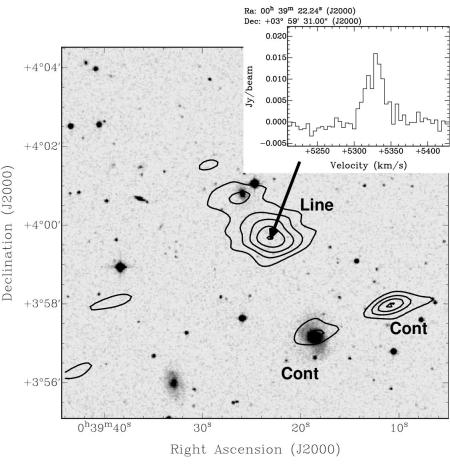
Using that approach Morgan and his colleagues decided to survey the sky in the radio band, and when they found a source, check what was there in the optical. The next figure shows some typical results, with a radio spectrum superposed on a negative image (easier to see) of the corresponding area of the visual sky..

Here are radio scans of the sky made with the Parkes Radio Telescope superposed on negatives of the optical sky behind. The receiver is tuned to the frequency of gaseous Hydrogen receding from the Earth at the velocities ( in Km/sec) shown at bottom. The two upper spectra corresponded to giant spiral galaxies, bottom left to a dwarfish Irregular galaxy, and bottom right to a dim galaxy barely visible above the sky. The area under each spectrum is a measure of the total amount of gas present while the width derives from the internal motions within the galaxy ,such as rotation. Much can be inferred from these measures. Copyright Monthly Notices of the Royal Astronomical Society.

Usually there is indeed a galaxy to be seen there. But of course the team were hoping to find cases where the optical counterparts were invisible — i.e. true ‘Hidden Galaxies’

A montage of galaxies found at Parkes and then observed in several colours with the Sloan Survey Telescope in New Mexico. The six bottom right are all colossal giants more massive than our Milky Way. Nevertheless, as you can see, some are very dim. This all ties in with the Wigwam diagram and indicates just how treacherous a purely optical survey of the Universe might be. Courtesy of Professor Julianne Dalcanton, University of Washington, Seattle

The figure above shows that, from time to time they came close. Each postage stamp in the montage shows the optical image corresponding to a radio signal found in a blind survey of the sky made with the Multibeam Receiver fitted to the Parkes Radio Telescope in Australia. As you can see some are almost invisible, lying in the very wings of the Wigwam diagram. It is important to emphasise that the Luminosity of a galaxy (which corresponds to the number of stars it contains — generally billions) and its surface-brightness (dimness) are entirely different concepts, the latter depending on how its Luminosity is spread out across the sky. Although the six galaxies bottom right are all luminous giants, some are nevertheless, extremely dim.

There is another trick though in astronomy for finding something invisible in Space: observe an object behind it and look for tell-tale gaps (‘spectral ghosts’) in its spectrum where specific atomic species in the invisible object have absorbed out the light coming from behind. That is what Frank Cotteridge and his like found, albeit by accident, when they observed the spectra of very distant Quasars — lots and lots of inexplicable absorption lines (‘spectral ghosts’). “What else could they be”, Morgan argued, “If not my Hidden Galaxies?” Thus the bitter battle over QSOALs or ‘Quasi Stellar Object Absorption Lines’ began (see especially “Crouching Giant“).

The spectra of Quasars showing the many absorption lines (spectral ghosts) etched into them. Measurements show they are caused by clouds of atoms like Hydrogen and Nitrogen lying in the foreground along the line of sight to the quasar. But what form could those clouds take? Morgan claims they are the numerous Hidden Galaxies you would expect. Opponents who don’t like that idea are forced to postulate that visible galaxies must have absolutely vast gaseous halos surrounding them. Controversy continues [see Whispering Sky and Crouching Giant in particular]. As you go down the montage one is looking at higher and higher redshift quasars. Out there, back in time, the absorbing clouds appear to have been crowded closer and closer together. The humps are features in the spectra of the Quasars themselves. Copyright The European Southern Observatory (eso.org).

In 1987 the whole field was electrified by a paper written by Greg Bothun, Chris Impey and colleagues who were then based in California. Quite by accident, while observing dwarf galaxies in the nearby Virgo Cluster, they noticed that one wasn’t a dwarf, but the nucleus of a “Crouching Giant”, that is to say of an absolute monster of a spiral galaxy 25 times further away than the cluster but too dim to show much of itself above the sky. Here was unequivocal evidence that Hidden Galaxies of the most dramatic kind actually existed.

The Crouching Giant found by Greg Bothun, Chris Impey and co. by accident in 1987. The bright nucleus (this is a negative) was thought to be a dwarf galaxy in the nearby Virgo Cluster. But some very smart detective work revealed that it was instead the core of an absolutely colossal but dim giant spiral 25 times further away, whose spiral arms you can just pick out. It is no less than half a million light years across, ten times the extent of our own colossal Milky Way. Because of the accidental way it was found, finding others like it would be infernally difficult. Copyright Astronomical Journal 1987

That might have been that — except that nobody could find another such. The sceptics could, and did, write it off as a freak. If Hidden Galaxies were to become ‘significant’ they needed to make up a healthy fraction of the cosmic light and mass. In other words astronomers needed to find lots of Crouching Giants.

And how we all tried! But even when Jon Davies & co. did find one at Jodrell Bank (below) the opposition was fanatical.

Theoreticians who’d ‘proved’ that Hidden Galaxies couldn’t exist were furious; observers with even bigger telescopes than Jodrell were adamant that if they hadn’t found one then certainly we could not. And then there were the computer modellers who, at the drop of a hat, could prove or disprove anything, often without acknowledging the manifold frailties of their craft.

The putative Dark Galaxy VirgoHI-21 in the Virgo cluster. Left shows the radio contours superposed on a negative optical image. (Data obtained with the Westerbork Array in Holland) The giant spiral NGC4254 has obviously been disturbed by an encounter with a massive object which could only be Virgo HI-21, which is Dark, but note the bridge of gas between them. But the dynamical map (Right) shows it is spinning rapidly which can only mean that it is indeed massive. Massive, dark, spinning; what else could it be but a Dark galaxy? Copyright The Astrophysical Journal, 2007.

So although , after titanic refereeing battles, Virgo HI-21 did eventually get published in the prestigious Astrophysical Journal, most of the self appointed ‘experts’ stubbornly refused to acknowledge it as the first Dark Galaxy. But, in my opinion, if you read all the arguments carefully enough, it cannot be anything else.

In Big Science the problem is very often Lack of Breadth, rather than Lack of Depth. The clues are here and there but who has the breadth to spot them all, and assemble a coherent picture? Often we fail because no one individual in the field has the required breadth. And then there are the Systematic Errors that can bedevil any ambitious undertaking, errors held on to fanatically, especially by those who do not appreciate the frailty of The Scientific Method, and the need for caution in applying it (See my book Thinking for Ourselves) . This is highlighted in the following image based on observations we made with the Jansky Telescope in New Mexico, much the most powerful radio telescope on Earth at present. It reveals a huge cloud of hydrogen, the signature you would expect of a Dark Galaxy, but with a giant but optically visible galaxy to the South, receding away from us at the exactly the same speed as the Hydrogen. Previously the Parkes team, to which I then belonged, had mistakenly identified that as the source of the Hydrogen, and so overlooked what appears to be a true dark galaxy. Galaxies, Dark or Light, cluster so gregariously together that one needs a very powerful beast like the Jansky, to distinguish between them. None of us fully appreciated that, certainly not the Quasar observers with their spectral ghosts, who could always postulate, around visible galaxies, ‘gaseous haloes’ of unlimited size, to discount the invisible ones, which is what most of them choose to do.

What a Dark Galaxy ‘looks like’. Parkes 0039+03 was first discovered as a massive Hydrogen source out at 5,300 km/sec recession-velocity by Morgan and co. using the Parkes dish. They mistakenly associated it with the luminous optical galaxy (marked ‘cont’ here ) which happened to have an almost identical radial velocity, even though it is rather far away on the sky. But much later these more precise observations with the colossal Jansky array revealed that the Hydrogen and the bright galaxy are unassociated, as you can see. Even later a much deeper optical observations of the cloud made with the William Herschel 4.2 metre telescope in the Canary Islands revealed that it has tiny patches of light in it, but that is all. The strong clustering of galaxies together, both in space and in velocity, makes the search for Dark galaxies far harder than anyone had imagined. But if this isn’t a dark galaxy then what is? We found more like this out there.

BRILLIANTS

Thus far I have spoken entirely of Icebergs, hidden below the sky on the right hand (dim) side of the Wigwam; what about the ‘Brilliants’ on the other? They would be even harder to find so Morgan and co almost forgot them altogether. Apart from anything else, being compact, they would be largely shrouded in their own smoke, disguising their true brilliance, appear like ordinary galaxies, but far far in the background, and therefore of no particular interest.

It was only after WFC-3 was operating on Hubble (2009) that Morgan began to worry about the extremely high redshift galaxies dotted all over the background in deep Hubble images (see below). If the universe were really expanding they oughtn’t to have been there — dimmed out of visibility by the so called ‘Tolman Effect’. And they turned out to be very small physically, much smaller than galaxies of the same luminosity situated close by to us in Space. Then the penny dropped with a clang for Morgan. Here were his Brilliants but at very high redshift, dimmed just enough by expansion to place them in the Visibility Wigwam where they became possible for us to see. The implications though were startling: Space must be inhabited by vast numbers of Brilliants , just as it probably was by Icebergs. And together all their extra radiation would have sufficed to re-ionise the Universe — otherwise a major problem for Cosmology. So it all fitted together: Hidden Galaxies, Expansion, Brilliants, the Wigwam diagram, Reionisation…….if Morgan was right. If…….. This was the theory which obsessed him towards the end of Beyond the Western Stars.

The Hubble Ultra Deep Field, the deepest image ever taken. In an expanding universe distant galaxies ought to be dimmed to the point of invisibility by straightforward physical effects. Yet here they are, dotted all over the place. Either the universe isn’t expanding or these are normally invisible Brilliants, shifted into the Wigwam by redshift so as to be visible. Courtesy ESA/NASA

Who was right, and who was wrong can only be decided by posterity . But in my story of Hidden Galaxies I have tried to convey, above all, just how engrossing it all was: the tournament of ideas, the clashes of personality and ambition, the conflicts of evidence, the camaraderie, the bravery and the cowardice, the wild misunderstandings and the hazards of fortune……. They make science such an exciting career; though not one for the faint-hearted.

PS. I have actually left out the biggest reason for mystery here, because it has a post of its own entitled HOW DARK IS THE NIGHT?

Professionals who would like to see a fairly up-to-date review of this subject can look at my opening address to the International Astronomical Union symposium No.355 held at the IAC in Tenerife in 2019 entitled “The Realm of the Low Surface Brightness Universe” (Procs. edited by David Valls- Gabaud to appear soon in CUP) at:

https://mjdisney.org/wp-content/uploads/2020/11/hgreview7sept.pdf

THE HUBBLE SPACE TELESCOPE

November 5, 2020

Given that there are roughly ten tons of turbulent murky atmosphere above every square metre of the Earth’s surface it is a wonder that we can see the Cosmos at all. Thus the urge to orbit a big telescope above that atmosphere was irresistible. So in 1976 NASA and ESA put together a joint mission , which was eventually to be christened ‘The Hubble Space Telescope’ (HST) after Edwin Hubble. If, and it was a very big if at the time, all went according to plan, the prospects were breathtaking. The machine would image the Cosmos in a thousand times more detail, and across an eight times greater colour range than its ground based counterparts. Because of its accuity it would begin to see the Universe actually moving for the first time. Furthermore it ought to detect objects a hundred times fainter and thus ten times further away, and because light has a finite speed that meant it would be a Time Machine able to observe the Universe as it was long before the Earth and Sun were born. No wonder some suggested it would become “the most exciting project ever undertaken by mankind”.

This illustration shows the NASA/ESA Hubble Space Telescope in its high orbit 600 kilometres above Earth. It’s about the size of a bus while the ‘wings’ are solar panels

But if it was to succeed there were huge challenges to overcome. How was a mirror of the required precision ever to be made? How could the telescope take pictures up there and then return them to Earth? Given that there would be no crew (too clumsy), how was it first to find its targets and then hold steady on them with unheard of precision? How could it be serviced, or repaired if things went wrong, as they were bound to do on on a spacecraft far more complex than any nuclear-powered aircraft carrier?

Nobody knew the answers. But that was half the point. Like JFK challenging the Apollo Mission to get to the Moon in the 1960s “……not because it is easy, but because it is hard” so NASA and ESA were throwing down the gauntlet to their successors. “Here” they said to their selected teams “Here’s a problem we can’t solve. You go crack it. But you’ve only got so long!” And that of course was the very kind of challenge which inspires scieneers.

Astronauts installing WFC-3 camera on Hubble Space Telescope in 2009

Teams, committees, call them what you will, were the secret, and the Camera Teams were at the very heart of the entire enterprise. Only the cameras on board could exploit the full power of the telescope, and so deliver its most ambitious science. But what was that science to be? Before they designed a single lens it was those instrument teams , and those alone , which had to peer far into the future and try to imagine the most exciting questions that the telescope would be called upon to answer.

I was lucky enough to attend the first meeting of the Faint Object Camera team in 1977, and the last meeting of the Wide-Field-Camera-3 team, in 2010. So I feel well placed to describe our long voyage of discovery, as one of the on-board crew. I have chosen to tell it in novel form because what was to happen had to first germinate in the human heart and mind, the drivers of everything else. It also allowed me to cut many a tedious corner while keeping the true cast of thousands to less than Tolstoyian size. I hope readers, and in particular fellow members of the crew, will forgive me for that, and certainly for omitting episodes and heroes they feel should have been included. But this is meant to be a human story of a very human endeavour, not the synoptic history which will no doubt emerge when we have all gone.

Since The HST story occupies much of my three novels:

The Whispering Sky ( 1976 to 1983)

Crouching Giant (1983 to 1995). and

Beyond the Western Stars (1996 to 2011)

all Amazon Publishing (2020)

I won’t say more here. You can see then all described here under the ‘My Books’ Category.However I intend to add, from time to time , images and scraps which could enrich the reader’s experience of the adventure. and I would be grateful if readers, or ex-comrades, could suggest more.

Here is the recent Ultraviolet Ultra Deep Field image taken with Hubble WFC-3, the deepest picture of the universe ever taken, and illustrating its capability as a Time Machine. Apart from the odd spikey star all the objects are galaxies vast distances away. The tiniest reddest ones have redshifts as large as 7 indicating that we are seeing them as they were over ten billion years ago. The Sun is only 5 billion yeas old. Copyright NASA/ESA/stsci.

Hubble would have been a disaster without the Space Shuttle, which not only launched it back in 1990 but visited it 5 times thereafter, to adjust for the flawed mirror, make innumerable repairs, and install new instruments like WFC-3, the camera which is still up there working perfectly after 11 years in orbit. Man seldom gets things right first time; we do our best by tinkering, by Evolution. Without Shuttle that would not have been possible, and I fear that HST’s successor, the James Webb Space Telescope, whose launch has been postponed at least a dozen times already, could be a disaster because it has no such means for repair. Anyway below you will see a panoramic view of the Cape Canaveral launch-site in 2009 with Shuttle Atlantis on Pad 39-A about to go up on its final mission STS 125 to the telescope, carrying WFC-3, along with its brave crew. In the background is Shuttle Endeavour on Pad 39-B, standing by to act as a Lifeboat to bring the crew back should Atlantis experience a serious failure, as happened with Columbia. In the background is Merritt Island nature reserve. If you zoom in enough, you might spot Morgan swimming up one of the alligator infested creeks to get as near to Atlantis as he could.

Those interested in following up the treasury of wonderful Hubble images and what they signify, can go to websites such as stsci.edu, nasa.gov, eso.org , http://www.cosmos.esa.int, and http://www.spacetelescope.org.